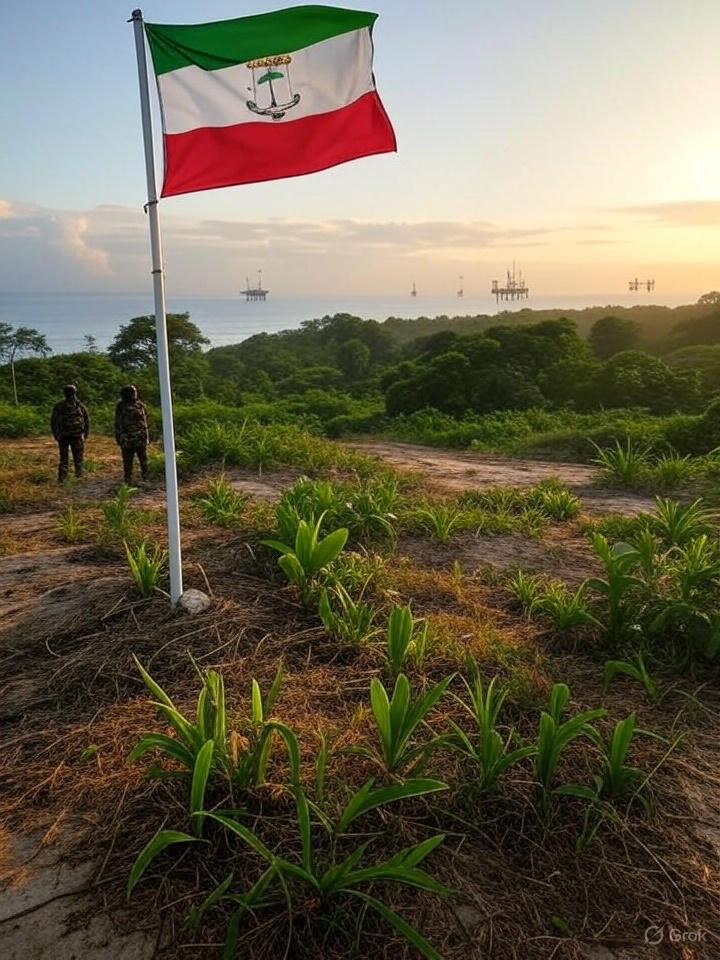
For decades, the tiny 30-hectare Mbanie Island, nestled in the oil-rich waters of the Gulf of Guinea, has been at the heart of a bitter territorial dispute between Gabon and Equatorial Guinea. On May 19, 2025, at 07:49 PM WAT, the International Court of Justice (ICJ) in The Hague delivered a landmark ruling, affirming Equatorial Guinea’s sovereignty over Mbanie and two smaller nearby islets, Cocotier and Conga. The decision, grounded in a 1900 colonial treaty between France and Spain, marks the end of a long-standing conflict that has fueled tensions between the two West African nations. As Gabon prepares to withdraw its military presence from the disputed area, the ruling is poised to reshape the region’s energy landscape and redefine the balance of power in the Gulf of Guinea.
Mbanie Island
Though small in size—roughly the equivalent of 74 acres—holds outsized significance due to its strategic location. Situated just 300 meters off the southern coast of Gabon’s Corisco Bay, the uninhabited island sits atop waters believed to contain substantial oil and gas reserves. The Gulf of Guinea is a critical energy hub, with the region producing over 5 million barrels of oil per day, according to 2024 estimates from the African Energy Chamber. For both Gabon and Equatorial Guinea, two of Africa’s major oil producers, control over Mbanie represents not just a matter of national pride but a gateway to economic prosperity. The dispute over the island dates back to the 1970s, when both countries began asserting claims following their independence from colonial powers—Gabon from France in 1960 and Equatorial Guinea from Spain in 1968.
The ICJ’s ruling hinges on a 1900 treaty signed between France and Spain, the colonial powers that once controlled Gabon and Equatorial Guinea, respectively. The treaty delineated maritime boundaries in the Gulf of Guinea, placing Mbanie, Cocotier, and Conga under Spanish jurisdiction, which Equatorial Guinea inherited upon independence. Gabon, however, has long contested this interpretation, arguing that the islands’ proximity to its mainland and historical usage by Gabonese fishermen supported its claim. Tensions escalated in 2003 when Gabon established a military presence on Mbanie, prompting Equatorial Guinea to accuse its neighbor of occupation. Diplomatic efforts to resolve the dispute, including a 1974 agreement to jointly administer the island, failed to produce a lasting solution, leading the two countries to seek arbitration from the United Nations in 2016.
The ICJ’s decision on May 19, 2025, was unanimous, with all 15 judges siding with Equatorial Guinea. In its 82-page judgment, the court reaffirmed the validity of the 1900 treaty, stating that “the historical record clearly establishes Spain’s—and subsequently Equatorial Guinea’s—sovereignty over the islands.” The court dismissed Gabon’s claims based on geographical proximity, emphasizing that international law prioritizes historical treaties over physical closeness in such disputes. As part of the ruling, Gabon is required to withdraw its military forces from Mbanie within 90 days, a move that President Ali Bongo Ondimba’s administration has reluctantly agreed to comply with. “While we respect the court’s decision, we remain committed to ensuring the rights of our citizens in the region are protected,” Gabon’s Foreign Ministry said in a statement on May 20, 2025.
For Equatorial Guinea, the ruling is a significant victory. President Teodoro Obiang Nguema Mbasogo, who has led the country since 1979, hailed the decision as a “triumph of justice” during a televised address on May 20, 2025. The win strengthens Equatorial Guinea’s position in the Gulf of Guinea, potentially unlocking new opportunities for oil exploration and development. The country, which relies on oil for over 70% of its GDP, has seen production decline in recent years due to maturing fields. Mbanie’s waters could provide a much-needed boost, with estimates from the U.S. Geological Survey suggesting the area may hold up to 1 billion barrels of untapped oil reserves. Equatorial Guinea has already begun discussions with international oil companies, including ExxonMobil and TotalEnergies, to explore the region, signaling its intent to capitalize on the ruling swiftly.
The decision also has broader implications for the Gulf of Guinea, a region already fraught with maritime disputes and security challenges. Piracy, illegal fishing, and oil theft have long plagued these waters, with the International Maritime Bureau reporting 132 incidents of piracy in the Gulf of Guinea in 2024 alone. The ICJ’s ruling could set a precedent for resolving other territorial conflicts in the region, such as the ongoing dispute between Nigeria and Cameroon over the Bakassi Peninsula. However, it also raises concerns about potential friction between Gabon and Equatorial Guinea. Analysts worry that Gabon’s withdrawal from Mbanie could lead to increased militarization of the surrounding waters as both nations seek to secure their maritime boundaries. “The Gulf of Guinea is a tinderbox,” said Dr. Amina Diallo, a West African geopolitics expert at the University of Lagos. “While the ICJ ruling brings clarity, it also risks escalating tensions if not managed carefully.”
Economically, the ruling could shift the energy dynamics in the region. Gabon, which produced 200,000 barrels of oil per day in 2024, may lose out on potential reserves in Mbanie’s waters, putting further strain on its already struggling economy. The country has faced declining oil revenues since 2014, exacerbated by global shifts toward renewable energy. Equatorial Guinea, meanwhile, stands to gain a significant economic lifeline, but its ability to develop Mbanie’s resources will depend on its capacity to attract foreign investment and navigate the region’s complex security environment. “This is a double-edged sword for Equatorial Guinea,” noted energy analyst James Carter in a May 21, 2025, interview with Reuters. “The opportunity is immense, but so are the challenges.”
The local impact on communities in Corisco Bay is another critical dimension. Gabonese fishermen, who have historically used Mbanie as a base for their operations, now face uncertainty about their access to the area. Equatorial Guinea has promised to work with Gabon to ensure “mutual cooperation” in the region, but details remain scarce. Community leaders in Corisco have called for dialogue to prevent the ruling from disrupting livelihoods. “This island may be small, but it means everything to our people,” said Jean-Marc Eyi, a fisherman from Port-Gentil, in an interview with Al Jazeera on May 20, 2025.
As the dust settles on the ICJ’s decision, the world is watching how Gabon and Equatorial Guinea will navigate this new chapter. The ruling not only resolves a decades-long dispute but also underscores the enduring relevance of colonial-era treaties in shaping modern geopolitical realities. For the Gulf of Guinea, Mbanie Island may be a small speck on the map, but its impact looms large, with the potential to redefine borders, economies, and regional stability for years to come.
For more updates and analysis, visit our
LJ News.
WhatsApp
Facebook